The accident on the way home
Fifteen years old. Two hundred metres from home.
The story of Nikita Reshetnikov · Cyprus
Two hundred metres from home, Nikita was hit by a car. A severe spinal cord injury. First, a hospital bed. Then, a wheelchair. Everyday life became something he had to learn again.
His family needs support for continued rehabilitation, possible surgery and a home designed around Nikita’s needs.
01 / Before
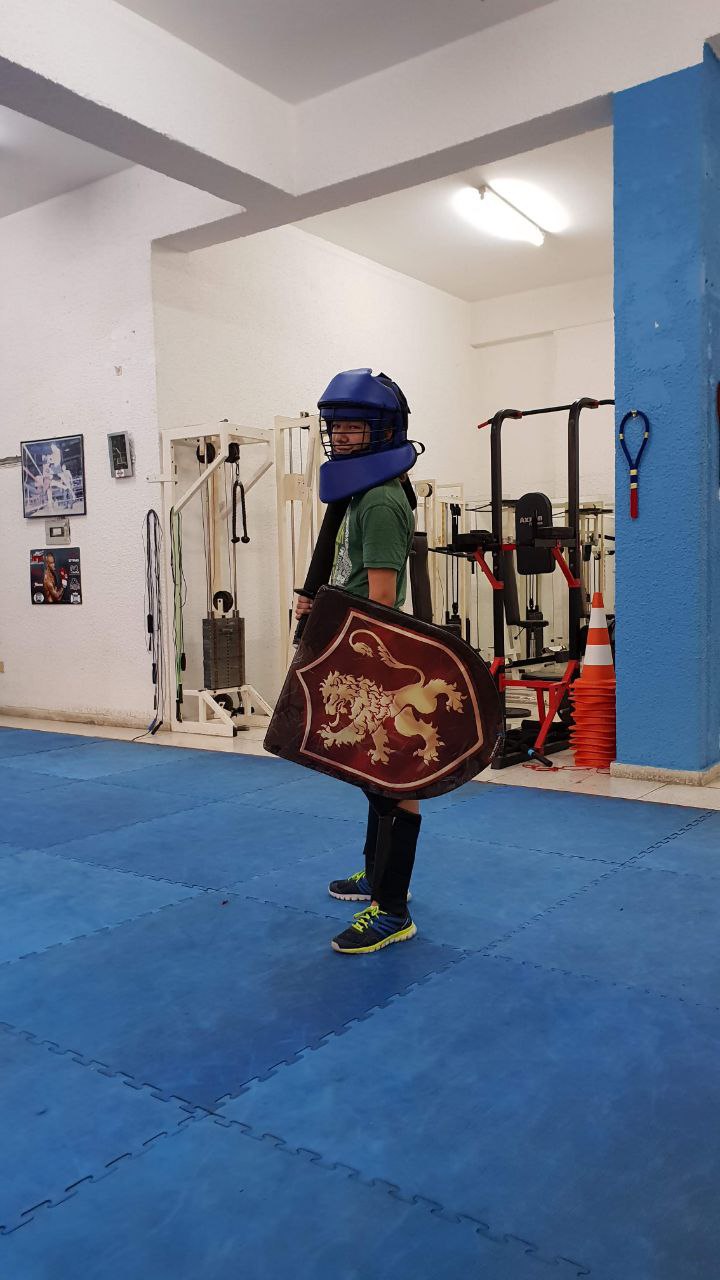
Nikita practised modern sword fighting, played guitar, studied and spent time with friends. Representing Cyprus, he won several international championships, a Cyprus championship, and gold and silver medals.
He could walk ten kilometres around town in a day. At fifteen, he had music, sport, friends and plans for his life.
02 / 15 October 2021
On 15 October 2021, Nikita was walking home from school. He had about two hundred metres left to go.
It was a sunny day. Nikita was crossing a straight, almost empty road away from a pedestrian crossing. A car suddenly moved left out of the right-turn lane and accelerated. The impact threw Nikita several metres and tore the straps from his school backpack.
Oleg received a call from an unfamiliar number, then heard his son’s voice. An ambulance took Nikita to Limassol General Hospital. Examination showed a cervical vertebral fracture and spinal cord damage.
After the accident, he was transferred from Limassol to neurosurgery at Nicosia General Hospital. The next day brought two complex operations and around eight hours under anaesthesia. Surgeons stabilised his spine and relieved pressure on his spinal cord.
His legs no longer moved. Some arm movement remained, but his hands barely worked. Sitting, holding a spoon and using a phone all had to be learned again.
"In a way, I became his arms and legs."
Spinal cord injury at C5, with spinal stabilisation at C4–C6. The 2026 assessment describes incomplete tetraplegia, AIS B under the international ISNCSCI classification; sensory level C5, motor level C6. It severely limits movement in his legs and arms and affects many everyday functions.
The investigation lasted more than a year and ended in late 2022. Police found the driver not at fault and did not refer the case to court. The driver received no penalty, not even a fine. The family has still not received the complete investigation materials.
The family brought a separate civil claim against the driver and his insurer. No compensation has yet been received. Court proceedings may take years. Treatment, care and rehabilitation must be paid for every month without waiting for a judgment.
03 / First times, again
Writing a message. Eating independently. Leaving hospital for a walk. Every milestone took time, training and enormous determination.
Fifteen years old. Two hundred metres from home.
The spine was stabilised and pressure on the spinal cord relieved.
A hoist transferred him into a special chair.
One word in the family chat. Learning to write again.
At first only in bed; it was still used for transfers.
A spoon strapped to his hand. His fingers still did not work.
Spoon and phone cuffs. Tightening the straps with his teeth.
After months in bed, upright with support from a device.
A chance to train his arms and propel himself.
A toothbrush attached to his hand. Online lessons also began.
A new clinic and more intensive individual rehabilitation.
An adapted vehicle made a simple outing possible.
Eating outside hospital for the first time in almost ten months.
Preparation, venue access and 160 kilometres of travel.
A short visit from the clinic to the apartment opposite.
The first in 14.5 months. New Year with the family.
526 hospital days behind him. Clinic visits continued for therapy and procedures.
In Limassol, for the first time since the accident, using a mobile stair lift.
A special support and physiotherapy made a new skill possible.
The pump continuously delivers medication to manage severe spasms.
Meeting teachers and classmates after 900 days.
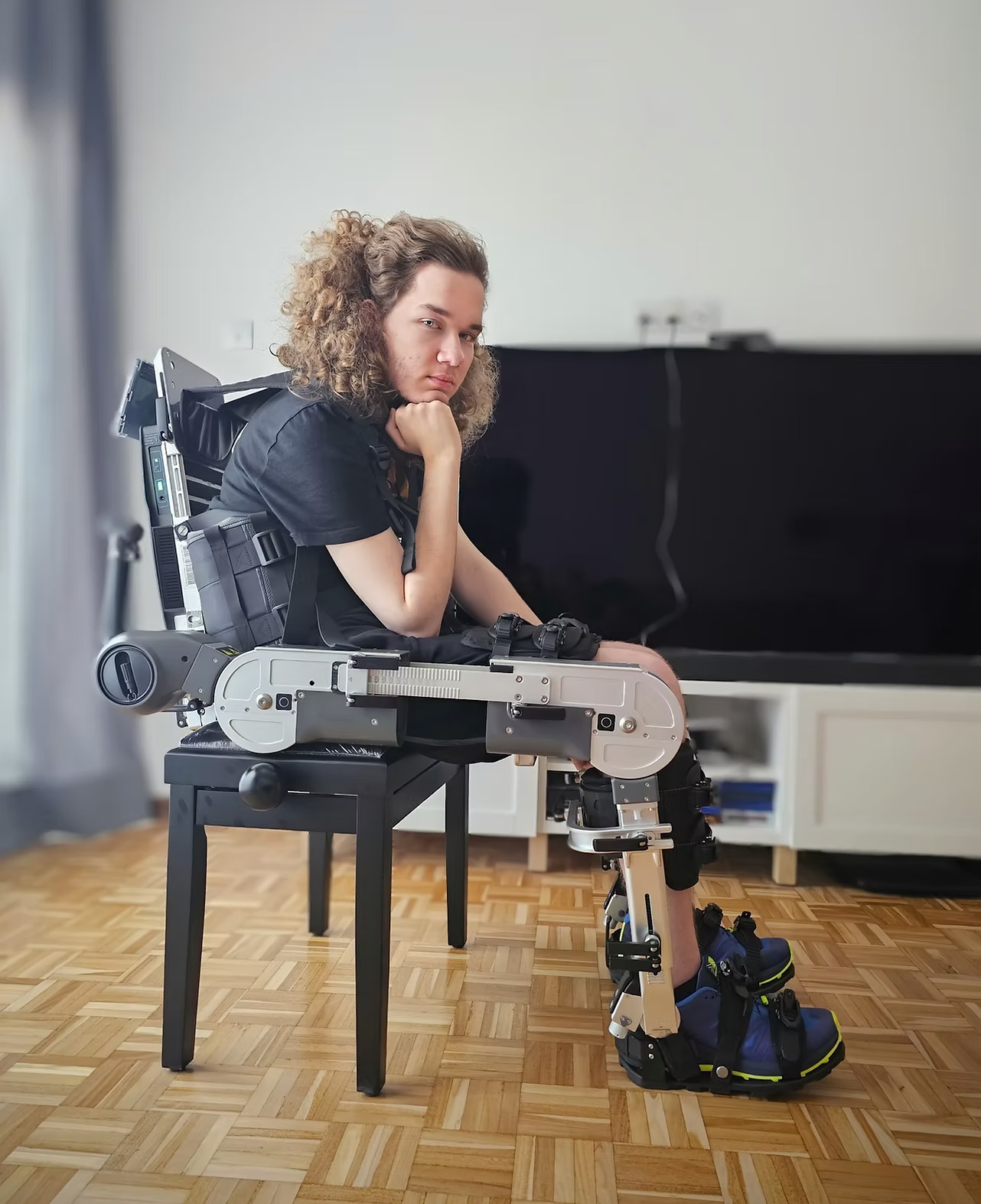
A robot moves his legs. Training reintroduces upright activity.
The full school programme completed alongside hospitals and daily rehabilitation.
Learning to use the device at home: first supported steps.
After school, distance learning and a new stage of life.
Continuing to study, meet friends and train every day.
04 / Every day
Leaving hospital did not mean treatment was over. Much of the work moved into the family home.
Medication, skin checks, hygiene, dressing, help with transfers and preparation for therapy. Getting ready takes about an hour.
Physiotherapy, movement and independence practice, trips to the clinic. Between sessions: university, friends and rest.
Hygiene, care, medication, transfer to bed and a comfortable sleeping position. Evening procedures also take about an hour.
This is not only about regaining movement. Without regular activity, muscle strength, joint mobility and skills already regained can be lost. Maintaining progress is daily work.
After a severe spinal cord injury, muscles without sufficient activity lose size and strength. Limited movement and muscle spasms can lead to lasting restrictions in joint movement. A break in rehabilitation can mean losing abilities gained through months of work.
Regular therapy helps strengthen muscles under voluntary control, maintain joint movement and practise balance, transfers and everyday tasks. Specialists may use assisted or equipment-based approaches for muscles with impaired control. The medical team determines the workload, rest and necessary pauses.
For Nikita, this helps preserve his current independence and physical condition so he can keep studying and living his life. If a suitable new treatment becomes available, he will also need the health and strength for assessment and rehabilitation afterwards. Today's therapy cannot guarantee future recovery, but maintaining his condition matters now.
05 / A home of his own
The family rents an apartment in Nicosia opposite the clinic. It is effectively a hospital room at home: a special bed, equipment, daily procedures, care and therapy. The small lift, narrow passages and rented accommodation limit what can be adapted.
A central goal of this appeal is to buy or create a home fully suited to Nikita’s life and rehabilitation. It needs safe access, an adapted bathroom, space for transfers, equipment and daily therapy.
A home of his own would allow long-term adaptations around Nikita’s needs, rather than the dimensions of an available rental.
06 / The cost of continuing
The total cost of treatment, rehabilitation and essential equipment has already exceeded €500,000. Hundreds of people helped make the first stage possible. But insurance does not cover long-term rehabilitation, care and much of the equipment needed.
Hospitals, physiotherapy, tests, medication, pain treatment, medical care and operations.
Exoskeleton, baclofen pump and implantation, a special bed and mattresses, wheelchairs, shower chair, lift and other support aids.
One adapted vehicle and accessible taxis for necessary journeys.
Additional costs associated with long-term treatment, care and Nikita’s daily needs.
Rounded estimates of the main costs, including continuing therapy and pain treatment. Expenses continue every month.
The family had health insurance with one of the best insurers and a very strong plan. Even these plans have limits on the duration and types of care they cover. Extensive cover for surgery and treatment does not mean insurance will pay for years of rehabilitation, ongoing care and equipment.
Insurance covered only the first months of treatment at Nicosia General Hospital. The policy had a coverage time limit of 1.5 years, but prolonged rehabilitation had separate restrictions. The family paid for further rehabilitation, the baclofen pump and its implantation themselves. Ongoing therapy, care and equipment are funded by the family and donations.
Health insurance and compensation from the driver’s insurer are separate matters. The family is pursuing accident compensation through court. Until it is received, regular expenses continue.
Hundreds of thousands of euros are needed again: for ongoing rehabilitation and care, an accessible home and future medical possibilities.
There is hope, but doctors cannot yet predict when or how much recovery might be possible. The family follows several treatment approaches undergoing clinical trials in different countries. Possible surgery would involve consultations, eligibility assessment, travel and substantial funding.
While these approaches are being researched, preserving Nikita’s health and present independence matters.
The family follows research that could improve movement and independence after spinal cord injury. None of these approaches means a guaranteed cure for Nikita. There are, however, reasons to keep following their progress.
Already used for specific functions
Electrical spinal cord stimulation combined with movement practice may improve specific functions. For example, ARC-EX is authorised in the US to improve hand strength and sensation in adults with chronic incomplete cervical injury. This is not authorisation to treat leg paralysis or a promise to restore walking.
Experimental implants
The system reads movement intentions and sends them to a stimulator below the injury. In a published study, it helped one person with chronic incomplete injury stand and walk. Research continues; a single participant's result cannot be generalised to every patient.
Early clinical research
Researchers are exploring cell technologies to support nervous tissue repair. CELLTOP primarily assessed safety in ten participants; some showed improvement. This is not yet a proven way to cure chronic paralysis.
Clinical development
Investigational medicines, including NVG-291, aim to create conditions that support neural repair. Their effectiveness and safety are being tested in clinical trials. They are not yet standard treatment that can simply be prescribed to Nikita.
Whether an approach is suitable for Nikita depends on clinical assessment and each programme's eligibility criteria. His current exoskeleton supports training and assisted movement; it does not itself repair the spinal cord injury.
Future medical options also require a financial reserve. Consultations, tests, travel with a care companion, possible surgery or a device, and prolonged rehabilitation may involve substantial costs. Even when a study funds the experimental treatment itself, associated costs may remain with the family. The exact amount is not yet known; the overall need for hundreds of thousands of euros also includes ongoing care and an accessible home of his own.
People beside Nikita
Hundreds of people made the first appeal possible. Some donated, some shared Nikita’s story, some recorded messages of support. Many people stand behind the next chapter.
Musicians, actors and creators recorded messages for Nikita. Their words helped him and his family through the hardest months.
Watch on FacebookFacebook video loads only when you press play. If the embedded player is unavailable, open the original.
Thank you to everyone who has helped and continues to help. More names are being added.
Thank you also to those who chose to remain unnamed.
07 / Help now
Support is needed for daily rehabilitation and care, future medical options and an accessible home of his own. The need is hundreds of thousands of euros. A donation of any size helps therapy continue; substantial support can secure it long-term and help create a home for living and rehabilitation.
Where possible, use Donation as the payment reference.
For cryptocurrency transfers, always check both asset and network. ETH and USDT on Ethereum share one address but are different assets.
You will continue to your chosen payment platform. Check the recipient, currency, fees and amount before paying.